LangZero

Why was LangZero developed?

When learning languages through videos, encountering unfamiliar words is very common. However, if you want to organize these words and add them to flashcard software like Anki, it often requires a significant amount of time to prepare materials such as example sentence translations, pronunciations, and definitions—making the learning cost quite high.

Furthermore, simply collecting words is not enough. Many words have different meanings depending on context, and to fully master their usage, you need to collect example sentences from various situations. This process is often tedious and time-consuming.

This led me to think: Could we develop software that allows users to focus solely on "collecting unfamiliar words" while leaving the learning and preparation of study materials to the system? This software would provide complete learning materials—such as multiple example sentences, audio, translations, and usage in different contexts—while also incorporating a spaced repetition learning mechanism like Anki.

Based on this idea, we developed LangZero.

LangZero

Documentation

Currently, LangZero only supports English learning, with Traditional Chinese, Simplified Chinese, and Japanese available as translation languages.

1

Design Philosophy and Features

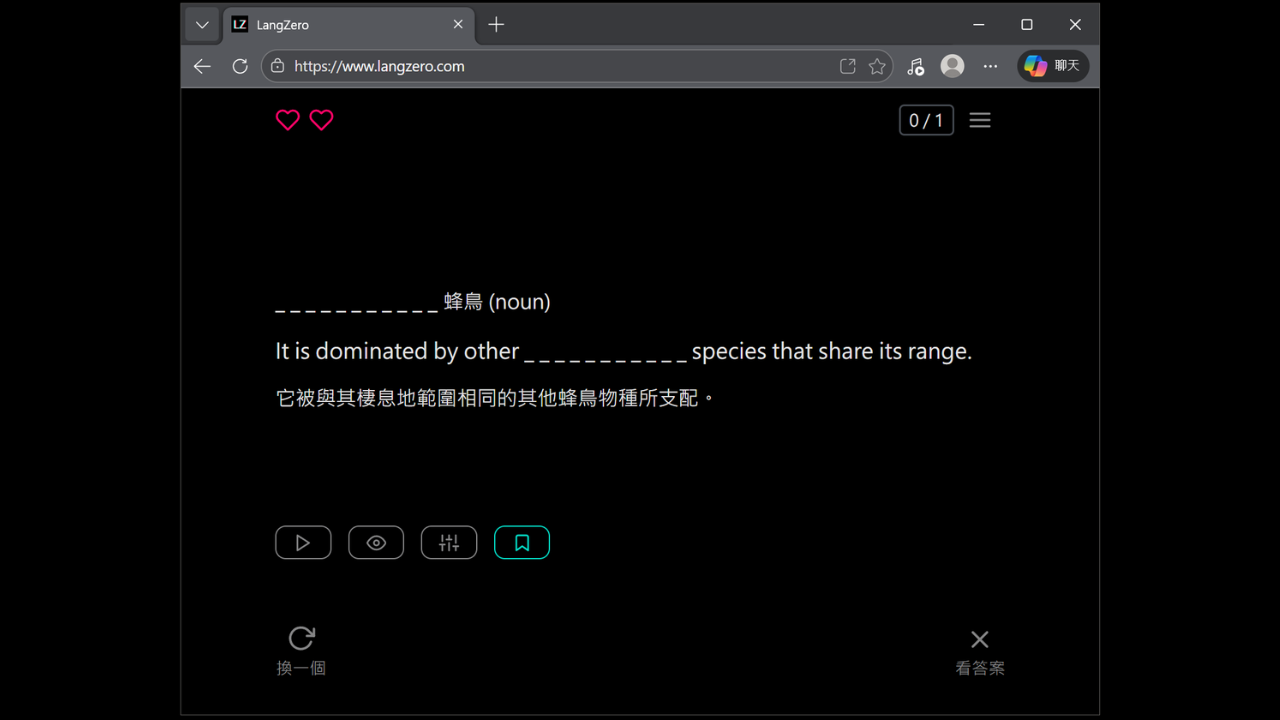
  • Example Sentences as the Core: Vocabulary removed from context is not only easy to forget, but its meaning often changes with context. LangZero uses "example sentences" as the core of learning, helping you understand words in real contexts and build long-term language intuition rather than isolated definitions.

  • Diverse Examples for Comprehensive Understanding: To prevent users from only memorizing fixed collocations, LangZero provides multiple example sentences for each word, covering different contexts and usages to help you fully grasp the actual meaning of the same vocabulary in various situations.

  • Single Definition Focus: Traditional dictionaries often list all definitions at once, which can easily cause information overload. LangZero adopts a "learn one meaning at a time" design, allowing users to focus on the usage in the current context, effectively reducing cognitive load and improving learning efficiency.

  • i + 1 Principle for Example Sentence Selection: All example sentences are filtered according to the i + 1 principle: while ensuring the sentence remains natural, they contain only one new target word whenever possible, avoiding interference from other unfamiliar words so you can focus on the current learning objective.

  • AI-Powered Generation and Understanding: All word definitions and translations are generated by AI models. Unlike traditional dictionaries, AI can understand the complete context and provide precise, context-appropriate explanations for specific example sentences rather than simply listing possible meanings.

  • FSRS Spaced Repetition Algorithm: LangZero employs the advanced FSRS spaced repetition algorithm, which dynamically adjusts review timing based on your actual memory state, reminding you to review at the optimal time to maximize long-term memory retention.

  • Spelling Practice: Through gamified input-based exercises, "reading, pronunciation, and spelling" are integrated into a single process, helping you truly master words rather than just passively recognizing them.

Current Status and Limitations

As an ongoing development project, the following limitations currently exist, and we are gradually optimizing:

  • Vocabulary Expansion in Progress: Currently, mainstream test preparation vocabulary is mostly complete, but some rare words and uncommon usages are still being continuously added.

  • Language Support: Currently only supports "English → Traditional Chinese / Simplified Chinese / Japanese." Support for more languages will be expanded in the future.

  • AI Translation Errors: Due to current model limitations, occasionally translations may not be precise enough. If you encounter such issues, we recommend using the "change example sentence" feature first. We will also continue to adjust the model to improve accuracy.